

The Stakeholder System Behind Custodial Excellence
The Stakeholder System Behind Custodial Excellence
How facilities can convert frontline judgment into better building outcomes
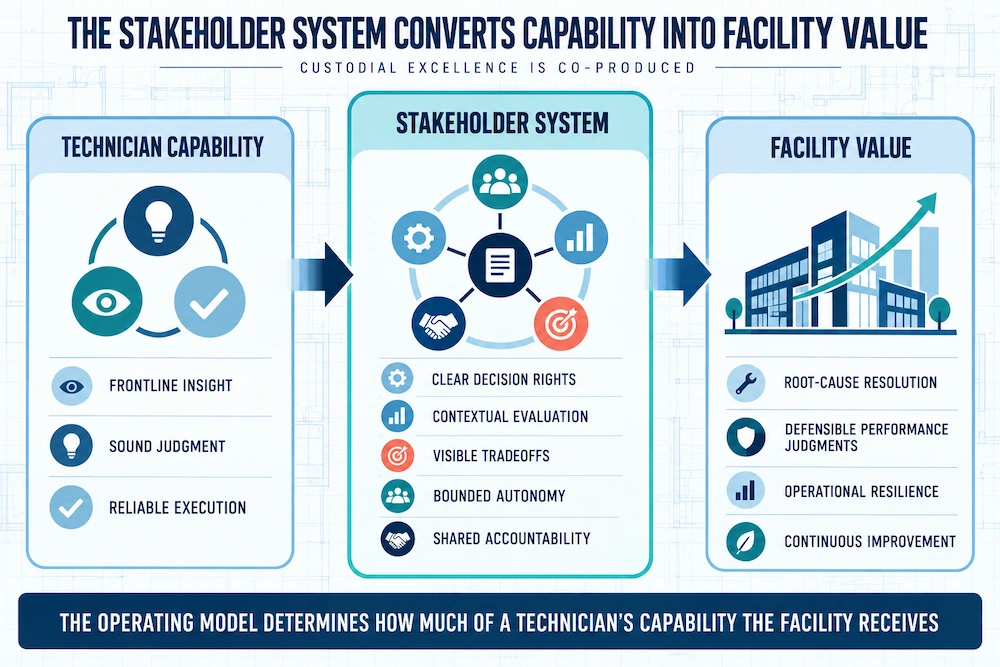
ustodial excellence is co-produced. C Technician capability creates greater facility value when the surrounding stakeholder system provides clear authority, contextual evaluation, visible tradeoffs, bounded autonomy, and shared accountability.
At a Glance
Custodial excellence is co-produced. Technician capability delivers full value only when the surrounding stakeholder system supports it.
Clear decision rights protect performance. Everyone may report a concern, but designated stakeholders should reprioritize work and make the tradeoffs visible.
Frontline insight must lead to action. Capture observations, test improvements, close the feedback loop, and evaluate stakeholders alongside technicians.
A capable custodial technician can complete an assigned route. An exceptional one can improve the system around it.
Consider a technician who notices that a campus corridor is routinely cleaned just before an evening program releases. Within minutes, the floor is soiled again, complaints return, and part of the work must be repeated. In one facility, the observation reaches someone who can act. The route is adjusted, the result is tested, and recurring work declines. In another, the response is simple: follow the checklist.
The difference is not the technician’s ability. It is the operating environment surrounding that ability.
Custodial performance is often treated as a direct product of hiring, training, and supervision. Those elements matter, but they are incomplete. Performance is also shaped by the people who set priorities, redirect work, interpret complaints, evaluate results, and respond when technicians exercise judgment. Together, these people form a stakeholder system.
When that system works, custodial teams do more than preserve appearances. They help resolve recurring problems, align service with building use, protect finishes, reduce repeated work, and make space available when occupants need it. The building gets better because they work there.
When the system fails, even a highly capable technician can be reduced to task execution. Observations go nowhere. Conflicting requests consume the shift. Performance is judged without context. Initiative gradually gives way to waiting for instructions.
A facility can recruit an exceptional custodian and gradually teach that person to provide ordinary service.
Avoiding that outcome requires more than encouragement. It requires deliberate choices about authority, information, feedback, and accountability.
1. Let everyone report concerns—but limit who can redirect the work
Facility occupants often see conditions that a manager does not. A teacher may notice a recurring spill. A receptionist may recognize that a public area needs attention before an event. A department leader may identify a room that must be reset sooner than planned. Each should have an accessible way to report what they see.
The ability to report a concern, however, is not the same as the authority to change the technician’s priorities.
When anyone can redirect the work, the technician effectively renegotiates the service scope throughout the shift—often with people who do not know what remains unfinished elsewhere. Responsiveness to one stakeholder can then appear as poor performance to another.
At the start of service, the facility and provider should establish four decision rights:
-
who may submit a request;
-
who may approve a change in priorities;
-
who resolves conflicting directions; and
-
who serves as the backup when the primary contact is unavailable.
The technician should know when to act, when to escalate, and where to take a request that would displace scheduled work. This arrangement does not silence occupants. It creates a broad channel for reporting and a narrow, accountable channel for reprioritization.
2. Evaluate the whole assignment—not only the most visible miss
The person most likely to receive a complaint is not automatically the right person to evaluate performance. Neither is the most senior person in the building or the occupant with the strongest preferences.
The primary evaluator should understand the agreed scope, observe enough of the operation to identify patterns, and have the authority to coordinate priorities with the service provider. Most importantly, that person should seek context before reaching a conclusion.
Suppose a technician is redirected to prepare a room for an unexpected meeting. Later, another stakeholder reports that a routine task was not completed. The observation may be accurate. Whether it represents poor performance is a different question.
The evaluator should ask:
-
Who requested the change?
-
Was the request authorized?
-
What work did it displace?
-
Could both assignments reasonably have been completed?
-
Was the tradeoff communicated?
The answers may reveal an appropriate decision, weak communication, an unreasonable request, insufficient capacity, or a technician who needs coaching on pace or prioritization. Each diagnosis calls for a different response. Treating all five as “the cleaner missed something” may correct the symptom while preserving the cause.
Context does not weaken accountability. It makes accountability accurate.
3. Make tradeoffs visible
Every additional request consumes some combination of time, attention, and supplies. Yet many custodial programs record only whether the original work was completed—not why priorities changed.
A simple service log can close that gap. When new work is accepted, the record should identify the request, the person who approved it, the approximate effort involved, and the work that will be delayed, deferred, or reassigned.
This is not documentation for its own sake. It serves three management purposes.
First, it gives the next reviewer enough context to evaluate the shift fairly. Second, it protects the technician from having to reconstruct competing directions after the fact. Third, it converts recurring exceptions into operating data.
If an “occasional” room setup displaces routine work several times each week, the facility is no longer dealing with an exception. It has uncovered a demand pattern. Leaders can then decide whether to change the schedule, revise the scope, add capacity, or accept a defined service tradeoff.
A strong technician should surface these conflicts early. A strong stakeholder should resolve them rather than assuming every request can be absorbed without consequence.
4. Give frontline judgment a controlled path to influence the operation
The people closest to the work often see patterns before management does. Custodial technicians learn when rooms actually become available, which entrances generate the most soil, where supplies create unnecessary travel, and which temporary fixes repeatedly fail.
That knowledge creates value only if the operating model provides a route for using it.
The wrong response to an observation is: “Do not worry about that. Just clean.”
The statement may appear to preserve boundaries, but it also communicates that attentiveness has little value. Repeated often enough, it teaches employees not to report what they see. A facility may later question their engagement without recognizing what happened when they attempted to engage.
Boundaries remain necessary. Some conditions belong to maintenance, safety, information technology, or another specialized function. Every shift also has limited capacity. The better response acknowledges both realities: “Please document that condition and send it to your supervisor so maintenance can investigate. Continue your current route unless priorities are formally changed.”
The technician now knows the limit of their authority—and that the observation mattered.
Facilities can go further by creating a simple improvement loop:
-
Capture the observation.
-
Identify the operational consequence.
-
Decide whether to test a change.
-
Define the technician’s authority and the boundaries of the test.
-
Review the result and close the loop.
Closure matters. A suggestion should be adopted, tested, deferred, or declined with an explanation. When every idea disappears into silence, employees learn that contributing beyond the checklist is wasted effort.
As sound judgment becomes evident, technicians can receive bounded discretion: adjusting the sequence of routine tasks around room availability, recommending a different supply location, or helping test a revised service schedule. Required procedures remain fixed, and changes beyond their authority still move through the appropriate decision-maker.
Greater contribution must also be supported with time, training, and recognition. Rewarding competence only with more requests eventually exhausts the people the facility most values.
For educational institutions, this principle carries particular weight. A campus exists to develop human potential and encourage learning. Extending that philosophy to the people who care for the learning environment is not merely symbolic; it gives the institution more capable employees and better ways of working.
5. Review stakeholder performance alongside technician performance
Service reviews typically focus on outputs: inspection scores, complaints, incomplete tasks, and corrective actions. A complete review should also examine the management conditions producing those outputs.
Leaders should ask:
-
Are technicians receiving contradictory instructions?
-
Are requests reaching the authorized decision-maker?
-
Are personal preferences being presented as contractual requirements?
-
Are priority changes and displaced tasks visible?
-
Do reported concerns reach someone who can act?
-
Do technicians receive closure on their observations and ideas?
-
Are recurring exceptions signaling a scheduling or scope problem?
The technician and provider supervisor should have a voice in this review. A facility contact may not know that several departments are independently assigning work or that a team member has stopped raising concerns after repeated dismissal.
Findings should lead to operating changes: clarify decision rights, coach a stakeholder on useful feedback, revise the escalation path, adjust the service plan, or reconsider who should serve as the primary facility contact. As staffing and building use change, a stakeholder arrangement that once worked may no longer fit the operation.
This creates balanced accountability. The service provider remains responsible for staffing, training, supervision, and execution. The facility remains accountable for the priorities it establishes, the directions it gives, and the context it uses to judge results.
What the facility gains
A stronger stakeholder system produces four practical benefits.
Better use of frontline intelligence. Recurring problems are more likely to be addressed at their source rather than repeatedly absorbed as cleaning work.
More defensible performance judgments. Leaders can distinguish execution failures from conflicting priorities, capacity constraints, and process-design problems.
Greater operational resilience. Clear authority and escalation paths reduce dependence on informal relationships or one experienced employee knowing how to navigate the building.
A stronger improvement culture. Technicians learn that useful observations receive a response, while stakeholders gain a disciplined method for testing ideas without surrendering control of the operation.
The broader principle is straightforward: custodial performance is co-produced. It reflects both the capability of the technician and the quality of the system in which that person works.
An exceptional technician needs stakeholders who can recognize ability, establish useful boundaries, and create room for judgment to produce results. Facilities should be as deliberate about choosing and equipping those stakeholders as they are about selecting the service provider.
The question is not only whether the facility hired an exceptional person. It is whether the operating model allows the facility to receive that person’s exceptional contribution.
About the Author
Delbert Kim
Chief Operating Officer, Getty Team
Delbert Kim focuses on facility operations, service delivery and the operating systems that help organizations improve consistency, quality and risk control across complex environments.
Build a janitorial program around how your facility actually operates.
Getty Team translates operating priorities into clear service design, accountable execution, and reliable facility outcomes.