

How Contamination Moves Through Outpatient Healthcare Spaces
How Contamination Moves Through Outpatient Healthcare Spaces
Outpatient healthcare cleaning is most effective when facility managers focus not just on individual surfaces, but on the interconnected touchpoints that move contamination throughout a space. A risk-based approach—prioritizing high-touch pathways, clear ownership, and verification—can make cleaning programs more effective without simply adding more labor.
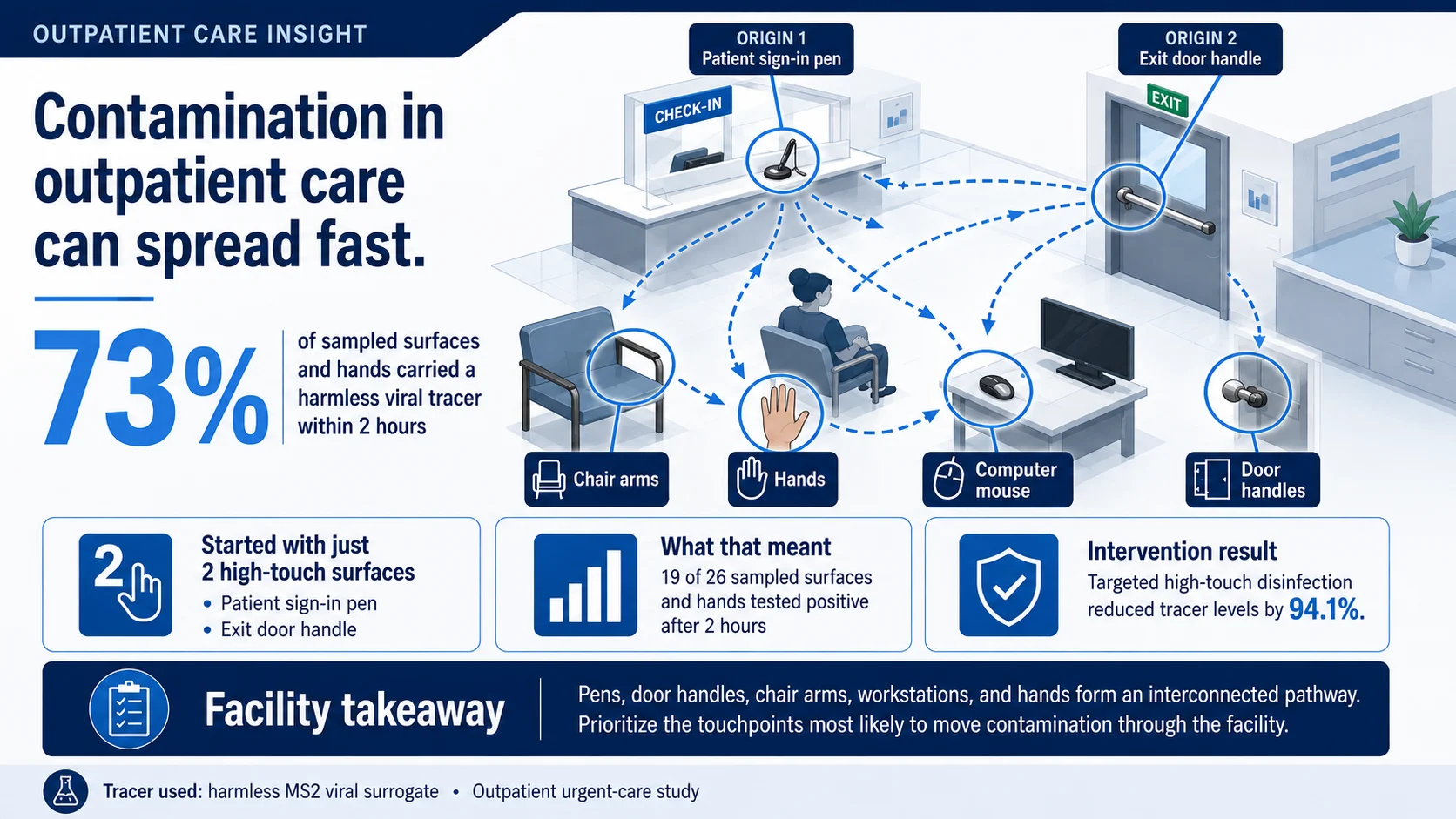
A harmless viral tracer introduced on just two high-touch surfaces spread to 73% of sampled surfaces and hands within two hours—illustrating how quickly contamination can move through an outpatient healthcare environment.
At a Glance
Contamination moves through pathways. In the study, a tracer introduced on just two high-touch surfaces spread to 73% of sampled surfaces and hands within two hours.
High-touch surfaces deserve priority. Door handles, chair arms, hands, pens, and workstations can act as interconnected transfer points throughout an outpatient facility.
Cleaning should be risk-based and verified. Effective programs define ownership, prioritize the most critical touchpoints, and confirm that cleaning is actually being performed as intended.
A viral tracer study offers a useful lesson for facility managers: high-touch surfaces do not operate independently. They form pathways.
In outpatient healthcare, environmental cleaning is often organized by rooms, surfaces and frequencies.
Clean the waiting room. Disinfect the exam room. Wipe the door handles. Service the restroom.
Operationally, however, contamination does not necessarily respect those boundaries.
A study published in the American Journal of Infection Control provides an unusually clear illustration of how quickly contamination can move through an outpatient environment—and why facility managers should think about touchpoint pathways, not simply individual surfaces.
Researchers introduced a harmless viral tracer onto just two commonly touched objects in an outpatient urgent-care clinic.
Within two hours, the tracer was detected on 73% of the surfaces and hands sampled.
The implication is not that every outpatient facility is heavily contaminated, nor that touching these surfaces necessarily leads to infection.
The more useful takeaway is operational:
What begins at one touchpoint can quickly become a facility-wide pathway.
The Study: Two Starting Points
Researchers from the University of Arizona used bacteriophage MS2—a virus commonly used as a harmless microbial tracer—to observe how contamination moved through an operating outpatient clinic.
Before the clinic opened, researchers placed the tracer on two surfaces:
- the front-desk patient sign-in pen
- the door handle exiting the patient-care area
The clinic then continued operating normally. Patient care, routine surface cleaning and hand-hygiene practices proceeded as usual.
Researchers sampled 19 environmental surfaces, four staff members’ hands and three to four patients’ hands at intervals throughout the day.
Two hours after the tracer was introduced, 19 of 26 sampled surfaces and hands—or 73%—tested positive for it. At 3.5 hours, 52% of samples remained positive, and at six hours, 54% were positive.
Among the most heavily contaminated sites during the study were:
- patient-room door handles
- patient hands
- staff hands
- nurses’ station chair arms
- a waiting-room computer mouse
The researchers concluded that contamination originating from only two high-touch points had moved into both patient-accessible and restricted staff areas.
That is what makes the study particularly useful from a facilities perspective.
The pen wasn’t simply a pen.
The door handle wasn’t simply a door handle.
They were nodes in a network of human movement.
Think in Pathways, Not Individual Surfaces
Consider a routine outpatient visit.
A patient enters the facility, checks in, uses a pen, sits in a waiting-room chair, opens a door and enters an exam room.
Meanwhile, staff members move between workstations, exam rooms, equipment, counters and shared spaces.
Each interaction creates another opportunity for material on one surface to move to a hand—and potentially from that hand to another surface.
CDC guidance similarly distinguishes high-touch surfaces from those receiving minimal hand contact and notes that microorganisms can transfer from environmental surfaces through hands. High-touch patient-care surfaces therefore generally warrant more frequent attention than low-touch surfaces.
For facility managers, that changes the question.
Instead of asking:
“Did we clean the waiting room?”
A more useful question may be:
“Which touchpoints connect the waiting room to the rest of the facility?”
Those are different ways of designing a cleaning program.
1. Map the Facility’s Touchpoint Network
Every outpatient environment operates differently.
A dermatology clinic does not have the same workflow as an imaging center. An urgent-care clinic does not operate like an outpatient surgery center.
Even facilities with similar floor plans can have very different patterns of patient and staff movement.
CDC environmental-cleaning guidance recommends identifying high-touch surfaces within each patient-care area and observing actual workflow, ideally in consultation with clinical personnel, because the critical surfaces can differ by room and facility.
A practical assessment might follow a patient from:
entrance → check-in → waiting area → clinical area → restroom → exit
Then perform the same exercise for employees.
The objective is to identify the surfaces that repeatedly connect those movements.
Some may be obvious—door handles, faucets and counters.
Others may not be.
Pens, tablets, chair arms, computer peripherals, shared equipment and staff workstations can become important simply because of how people actually use the building.
2. Define Who Owns Each Surface
One of the easiest ways for a surface to be missed is for everyone to assume someone else cleans it.
This is particularly relevant in outpatient healthcare, where responsibilities may be divided among clinical personnel, daytime staff and an environmental-services or janitorial provider.
A cleaning contractor may be responsible for nightly environmental cleaning while clinical employees handle equipment and between-patient turnover.
But what about the shared mouse at the nurses’ station?
The patient check-in tablet?
A blood-pressure machine?
A reception pen?
A chair used continuously throughout the day?
CDC guidance recommends that facility cleaning schedules clearly establish who is responsible, how frequently cleaning occurs and what method or product is used.
That clarity is more than an administrative detail.
It closes gaps.
3. Let Risk Determine Frequency
The tracer study should not be interpreted as an argument for continuously disinfecting every surface in the building.
That would be operationally inefficient and may offer little benefit for low-touch surfaces.
Instead, cleaning frequency should reflect risk.
CDC describes environmental-cleaning risk as a combination of:
- probability of contamination
- vulnerability of the patient population
- potential for exposure, including whether a surface is high-touch or low-touch
Higher-risk surfaces require more frequent or rigorous cleaning than lower-risk surfaces.
This creates an important distinction between cleaning uniformly and cleaning intelligently.
A floor and a door handle may be only a few feet apart, but they do not necessarily have the same role in a contamination pathway.
4. Targeted Intervention Can Matter
The researchers also tested a targeted cleaning intervention.
Four hours after introducing the tracer, selected high-touch surfaces were treated with the study’s EPA-registered ethanol-based disinfectant. Researchers sampled the environment two hours later.
Tracer concentrations were 94.1% lower following the intervention, a statistically significant result.
That result should be interpreted carefully.
It does not mean every high-touch cleaning program will produce a 94.1% reduction. The result reflects the specific product, protocol, facility and experimental conditions studied.
The study was also funded by GOJO Industries, the manufacturer associated with the disinfectant evaluated; the authors reported no conflicts of interest.
Still, the broader operational lesson aligns with CDC guidance: targeted cleaning and disinfection of frequently touched surfaces can be more meaningful than applying the same frequency to every surface throughout a facility.
5. Verification Matters as Much as the Checklist
A cleaning specification can say that door handles are disinfected.
That does not necessarily tell a facility manager:
- whether every relevant handle was identified
- whether the required frequency was achieved
- whether the correct product was used
- whether manufacturer contact-time instructions were followed
- whether responsibility was clear
- whether changing workflows have created new high-touch surfaces
For this reason, CDC’s environmental-cleaning framework includes not only standardized protocols but also monitoring, feedback, staff training and defined accountability.
The cleaning checklist remains important.
But the checklist should reflect the operating environment, rather than becoming the operating environment.
The Facility-Management Takeaway
The most interesting part of the outpatient tracer study isn’t simply the number 73%.
It’s what produced it.
Two touchpoints became many.
A sign-in pen and a door handle became part of a pathway involving patients, employees, workstations, furniture and clinical areas within a matter of hours.
For facility managers, environmental cleaning therefore should not be viewed solely as a collection of tasks:
wipe this, mop that, disinfect this room.
A stronger program considers how people move through the facility, which surfaces connect those movements, who owns those surfaces and how frequently intervention is appropriate based on risk.
Because sometimes improving environmental cleaning doesn’t require cleaning everything more often.
It requires identifying the surfaces that matter most—and making sure they do not fall through the gaps.
References
Reynolds, K. A., Sexton, J. D., Pivo, T., Humphrey, K., Leslie, R. A., & Gerba, C. P. (2019). Microbial transmission in an outpatient clinic and impact of an intervention with an ethanol-based disinfectant. American Journal of Infection Control, 47(2), 128–132. DOI: 10.1016/j.ajic.2018.06.017.
Centers for Disease Control and Prevention. CDC’s Core Infection Prevention and Control Practices for Safe Healthcare Delivery in All Settings. Guidance on environmental cleaning, high-touch surfaces and disinfectant use.
Centers for Disease Control and Prevention. Environmental Cleaning Procedures. Guidance on risk-based environmental cleaning, identification of high-touch surfaces, outpatient-care areas, cleaning schedules and defined responsibilities.
Centers for Disease Control and Prevention. Considerations for Reducing Risk: Surfaces in Healthcare Facilities.Framework addressing standardized cleaning protocols, monitoring, accountability and feedback.
About the Author
Delbert Kim
Chief Operating Officer, Getty Team
Delbert Kim focuses on facility operations, service delivery and the operating systems that help organizations improve consistency, quality and risk control across complex environments.
Build your healthcare cleaning program around how your facility actually operates.
Getty Team helps outpatient healthcare facilities translate patient flow, high-touch risks, and operational priorities into clear, accountable cleaning programs.